
What Is a vCIO (Virtual CIO)? Benefits and When to Hire One
By the DKBinnovative Crew | Published: July 30, 2026 | Reviewed by Peter Bertran, Chief Client Officer
Most business leaders don’t lie awake worrying about servers or software licenses. They worry about growth, risk, budgets, and whether their technology is helping or holding them back. What is a vCIO? It’s the answer to that worry: executive-level IT leadership, on demand.
Below, we explain exactly what a vCIO is, what they do, the benefits, when your firm is ready for one, which businesses gain the most — and how a DKBinnovative vCIO is built to be a genuine strategic partner, not a report generator.
What Is a vCIO (Virtual CIO)?
A virtual CIO, or vCIO, is an outsourced technology executive who provides the same strategic leadership as a full-time CIO, on a flexible basis. Rather than hiring a six-figure executive, your business gets a seasoned IT leader who owns your technology strategy, budgeting, vendor decisions, and long-term roadmap — and translates all of it into plain business terms.
The role sits above day-to-day IT support. A help desk fixes what’s broken; a Chief Information Officer decides where technology should take the business next. A vCIO delivers that higher-altitude thinking as a service — which is why the model has become so popular with small and mid-sized firms that need the strategy without the salary. Crucially, a vCIO isn’t just an outsourced technician with a nicer title; the value is in the judgment, planning, and business alignment they bring to every technology decision.
What Does a vCIO Actually Do?
A vCIO’s job is to make sure your technology is deliberately driving your business forward. Day to day, that looks like:
- IT strategy & roadmapping — a multi-year plan that maps technology to your business objectives, not a pile of disconnected tools.
- Technology budgeting — forecasting spend, planning hardware and software lifecycles, and removing surprise costs.
- Risk & security oversight — making sure cybersecurity, compliance, and business continuity are actually addressed at a leadership level.
- Vendor management — evaluating and coordinating the providers and platforms your business relies on.
- Business alignment — translating technology into outcomes leadership cares about: efficiency, growth, and reduced risk.
Much of this happens on a predictable cadence — typically a quarterly business review where your vCIO reports on progress, revisits the roadmap, flags emerging risks, and adjusts the plan as your business changes. Done well, a vCIO turns IT from a reactive cost center into a planned, measurable driver of the business.
How a Virtual CIO Builds Your Technology Roadmap
The technology roadmap is the vCIO’s central deliverable — the document that turns “we should probably upgrade that someday” into a deliberate plan. It usually starts with an assessment of your current environment: what you have, what’s aging out, where the security and compliance gaps are, and where technology is slowing the business down. From there, the vCIO maps initiatives to your business goals over a one-to-three-year horizon, sequences them by priority and budget, and ties each to a measurable outcome. The result is a plan leadership can actually understand and approve — no jargon, no surprises — and a clear answer to the question every executive eventually asks: “where is our technology headed, and why?”
Do You Need a vCIO? Signs Your Firm Is Ready
You don’t need to be an enterprise to benefit from a virtual CIO. These are the common signals that it’s time:
- Technology decisions are made reactively, one emergency at a time.
- Your IT spend feels unpredictable and hard to justify.
- You’re facing compliance pressure (SEC, HIPAA, PCI, cyber-insurance) and need a documented strategy.
- Leadership can’t get a clear, non-technical answer to “where is our technology headed?”
- You’re growing, merging, or opening locations and technology needs to scale with you.
Which Businesses Benefit Most From a Virtual CIO?
Almost any organization can use strategic technology leadership, but a few types gain the most from a virtual CIO. Regulated and professional-services firms — registered investment advisers, wealth managers, accounting and CPA firms, and law practices — face serious compliance and cybersecurity obligations without the scale to justify a full-time CIO, so a vCIO fills a real gap. Growing small and mid-sized businesses benefit when technology decisions start outpacing the leadership team’s bandwidth. And firms going through change — a merger, an acquisition, a new office, or rapid hiring — need someone to make sure technology scales with the business instead of becoming the bottleneck. If your technology carries real risk or is central to how you serve clients, a vCIO earns its place quickly.
7 Benefits of Hiring a vCIO
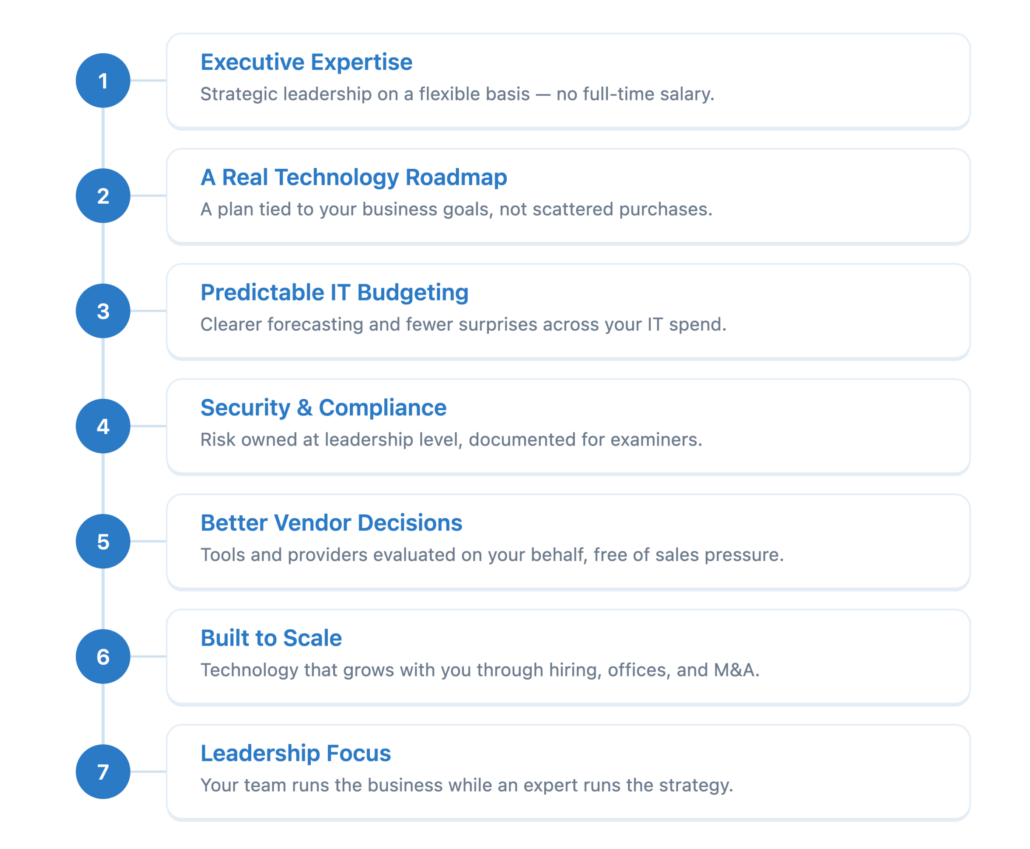
- Executive expertise without the executive salary. Strategic leadership on a flexible, scalable basis, so you pay for the guidance you need rather than a full-time headcount.
- A real technology roadmap. A plan tied to your goals instead of scattered, reactive purchases — so every dollar has a purpose.
- Predictable IT budgeting. Fewer surprises, clearer forecasting, and smarter spend across hardware, software, and services.
- Stronger security and compliance. Risk managed at the leadership level, with the documentation examiners and insurers expect.
- Better vendor decisions. An expert evaluating tools and providers on your behalf, free of sales pressure.
- Scalability. Technology that grows with you through hiring, new offices, or mergers and acquisitions.
- Focus. Your leadership team stays on the business while an expert owns the technology strategy.
vCIO vs. In-House CIO vs. Managed IT
These roles are easy to confuse. Here’s how they differ:
| Role | What it is | Best for |
|---|---|---|
| vCIO | Outsourced IT executive setting strategy, budget & roadmap | SMBs and professional firms that need strategy, not a full-time hire |
| In-house CIO | Full-time C-level employee owning technology | Larger organizations with the scale to justify the salary |
| Managed IT | Ongoing support, monitoring & maintenance of your environment | Any business needing reliable day-to-day operations |
The strongest setup pairs them: a vCIO sets the direction while managed IT services — or co-managed IT alongside your internal team — execute it. Strategy and delivery working as one system.
vCIO vs. vCISO: Strategy Meets Security
As firms take security more seriously, another role enters the picture: the vCISO (virtual Chief Information Security Officer). The simplest way to keep them straight is by focus. A vCIO owns overall technology strategy — roadmap, budget, vendors, and business alignment. A vCISO owns information security specifically — the security program, risk posture, and compliance controls. In smaller organizations one advisor may wear both hats; in more regulated or higher-risk firms, the two work as partners, with security getting its own dedicated leadership. For firms that need that deeper security focus, we also offer vCISO services for family offices and investment firms.
The DKBinnovative Difference: A Strategic Partner, Not a Report Generator
Plenty of providers will hand you a vCIO who runs a quarterly report and disappears. At DKBinnovative, we do vCIO differently. Your vCIO acts as your strategic advisor and partner — someone who takes the time to understand your business goals and then aligns your technology to reach them.
That means your DKBinnovative vCIO is in the room on the decisions that matter: where to invest, what risks to close, how to keep you compliant, and how technology can accelerate the outcomes your leadership cares about. It’s the difference between “here’s a status update” and “here’s how we move your business forward.” We start by learning your business — your goals, your clients, your pressures — and only then do we shape the technology plan around them, revisiting it as your priorities shift.
Good technology leadership is ultimately about aligning technology with business direction — a principle even national cyber authorities stress in their board-level guidance. That alignment is exactly what a DKBinnovative vCIO is built to deliver.
How to Get Started With a vCIO
Bringing on a vCIO is simpler than most leaders expect. It usually starts with a conversation about your business goals and current technology, followed by an assessment of where the gaps and risks are. From there, your vCIO builds the roadmap, sets the budget, and starts guiding decisions — as an ongoing partner, not a one-time project. There’s no need to rip out what’s working; a good vCIO meets your environment where it is and improves it deliberately over time.
Frequently Asked Questions
What is the difference between a vCIO and a CIO?
A CIO is a full-time, in-house technology executive. A vCIO (virtual CIO) delivers the same strategic leadership — IT roadmap, budgeting, risk oversight, and vendor management — as an outsourced service on a flexible basis, so smaller firms get executive-level guidance without a full-time salary.
What does a vCIO do?
A vCIO owns your technology strategy: building a multi-year IT roadmap aligned to your business goals, planning and forecasting your IT budget, overseeing cybersecurity and compliance at a leadership level, managing vendors, and translating technology into business outcomes for your leadership team.
How is a vCIO different from managed IT?
Managed IT keeps your technology running day to day — support, monitoring, patching, and maintenance. A vCIO works a level up, owning the strategy behind it: what to invest in, what to retire, how to budget, and how technology should support your goals. The two are complementary, and they work best together — strategy setting the direction, managed IT executing it.
Is a CIO higher than a CISO?
They are different roles. A CIO (or vCIO) owns overall technology strategy and operations, while a CISO (or vCISO) focuses specifically on information security and risk. In many organizations security reports up through the CIO, but the two are partners — strategy and security — rather than a strict hierarchy.
Do small businesses need a vCIO?
Many do. Small and mid-sized firms often face the same technology risks and compliance demands as large ones, but without an in-house executive to plan for them. A vCIO gives them that strategic leadership on a scale and budget that fits — which is why the model is popular with professional and financial-services firms.
The Bottom Line
A vCIO gives your business the executive-level technology leadership it needs to grow, stay secure, and spend smart — without hiring a full-time CIO. The real value, though, comes from having a vCIO who acts as a true partner. That’s the standard we hold at DKBinnovative: technology aligned to your goals, guided by an advisor who’s genuinely in it with you.
Talk to us about vCIO and IT consulting for your firm ?
Reviewed by Peter Bertran, Chief Client Officer, DKBinnovative.
Serving the DFW Metroplex

