
Managed IT for Private Equity Portfolio Companies | DKBinnovative

IT Built for the Deal Cycle

Managed IT for Private Equity Portfolio Companies

Sponsors do not buy help desk tickets. They buy predictable operations, clean diligence, and a portfolio that is easier to sell than it was to buy. DKBinnovative runs IT and cybersecurity across portfolio companies as one standardized program — pre-close diligence, Day 1 readiness, the hold period, add-on integrations, and the evidence buyers ask for at exit.


DKBinnovative team at their Frisco, TX headquarters delivering managed IT services
DKBinnovative engineer reviewing client IT infrastructure and security posture
Private Equity IT

What is managed IT for private equity portfolio companies?

Managed IT for private equity portfolio companies is a single outsourced technology and security program applied across every company a sponsor owns. It covers pre-acquisition diligence, Day 1 readiness, 24/7 operations through the hold period, add-on integrations and carve-outs, and the documentation buyers demand at exit. Instead of each portfolio company running IT its own way, the sponsor gets one control baseline, one reporting format, and one team accountable across the portfolio.

Why Sponsors Standardize

Three Reasons PE Firms Mandate One IT Partner Across the Portfolio

Risk You Can Actually See

A common control baseline — MFA, endpoint detection, managed backup, patching — applied to every company means you know the portfolio’s exposure without chasing each management team for answers. Gaps show up on a report, not in a breach notification.

Speed on Every Add-On

The tenth acquisition onboards like the first. Identity, email, endpoints, and monitoring follow a documented playbook, so integration stops being a bespoke project each time and stops consuming the operating partner’s calendar.

Exit Value You Keep

Buyers diligence technology the way they diligence financials. Asset inventories, security evidence, recovery test results, and clean license records assembled during the hold — not scrambled together in the last sixty days — remove the findings that turn into price adjustments.
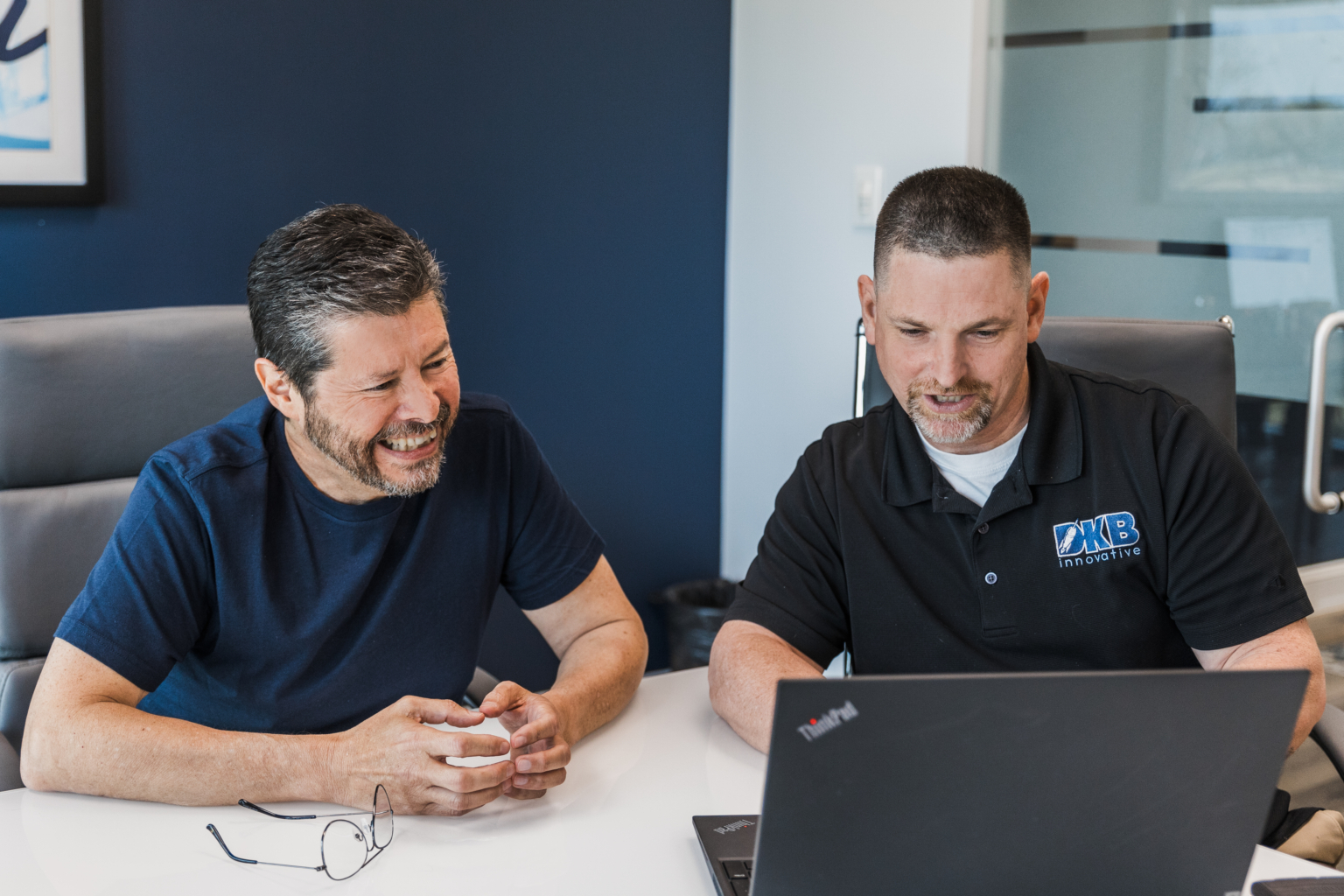

DKBinnovative team collaborating on IT standardization and documentation
46 Engineers

Available across every portfolio company

98.14%

Client satisfaction rating

3 Min

Average first response, including after hours

Sponsors and Operators Trust Us

We’d love to tell you about our work, but we’d rather show you.

Across the Deal Lifecycle

What IT Should Cover From Diligence Through Exit

DKBinnovative has supported investment and professional firms across the Dallas-Fort Worth metroplex since 2004. We are MSP 501 ranked and Inc. 5000 recognized, with a 24/7 in-house Security Operations Center and compliance engineers who work to SEC, SOC 2, and HIPAA requirements every day.

Before you sign, we assess what you are actually buying: infrastructure and cloud footprint, security posture, technical debt, licensing exposure, key-person and vendor dependencies, and the real cost to bring the company to a defensible baseline. You get a risk-ranked findings list with remediation estimates that feed straight into the post-close plan, on a timeline that fits a compressed deal. Our cyber due diligence playbook walks through the full process, and CISA’s guidance on managed service provider risk covers the controls buyers now expect to see.

The window right after close is when a company is most exposed and least documented. We stand up help desk coverage, deploy multifactor authentication and endpoint detection, validate that backups actually restore, and bring monitoring online — while the business keeps operating through the ownership change. Onboarding runs 45 to 90 days depending on complexity, with coverage live early in that window rather than at the end.

Day-to-day operations across every company: 24/7 help desk with a 3-minute average first response, patching, Microsoft 365 and Azure administration, network and endpoint management, backup and disaster recovery, and continuous security operations from our in-house SOC. Each company gets a named Client Experience Representative, and the sponsor gets consolidated reporting rather than five separate conversations.

Bolt-ons follow a documented onboarding path — identity and domain consolidation where it makes sense, email and data migration, network integration, and vendor rationalization. Carve-outs run the same discipline in reverse: standing up an independent, secure environment and managing the separation from the seller, including transition service agreement wind-down.

Sell-side diligence goes faster when the evidence already exists. Through the hold we maintain asset inventories, network documentation, security control evidence, incident records, recovery test results, and clean license and contract records — and we remediate the findings a buyer would raise before a buyer raises them. SOC 2 readiness is available where a buyer or customer base requires it — see the AICPA’s SOC 2 framework for what an examination covers.

DKBinnovative security operations team monitoring client environments
Frequently Asked Questions

Private Equity Portfolio IT FAQ

At minimum, sponsors should mandate a non-negotiable control baseline in every portfolio company: multifactor authentication, endpoint detection and response, managed and tested backups, patch management, email security, security awareness training, documented incident response contacts, and a current asset inventory. Above that baseline, mandate consolidated reporting — a common scorecard covering control coverage, open critical vulnerabilities, help desk performance, system availability, and integration milestones. Leave application and architecture choices flexible where forcing a migration would disrupt operations without creating value.

It is a single outsourced IT and security program run across every company a sponsor owns, rather than each portfolio company sourcing its own provider. It spans pre-close diligence, Day 1 and 100-day integration, hold-period operations including 24/7 help desk and security monitoring, add-on and carve-out execution, and exit-readiness documentation. The sponsor gets one baseline, one reporting format, and one accountable team.

The providers worth evaluating are the ones organized around the deal lifecycle rather than around help desk tickets. Test any candidate on five things: demonstrated diligence and carve-out execution, ability to manage multiple entities to a common standard, embedded security operations rather than bolted-on monitoring, sponsor-level portfolio reporting, and exit-readiness evidence maintained through the hold. DKBinnovative has served investment and professional firms since 2004 with a 24/7 in-house SOC, 46 engineers, and compliance work across SEC, SOC 2, and HIPAA requirements.

Full onboarding runs 45 to 90 days depending on environment complexity and how well the company is documented. Critical coverage lands much earlier: help desk, monitoring, multifactor authentication, endpoint protection, and backup validation are typically live in the first weeks, which is the period when an acquired company is most exposed.

No, and forcing it usually destroys more value than it creates. The right model is a mandatory control baseline with flexibility above it. Standardize security controls, documentation standards, procurement, and reporting across every company. Allow application and architecture differences where the operational case supports them. Consolidating tenants or platforms is worth doing when integration economics justify it, not as a reflex on Day 1.

A useful diligence pass covers infrastructure and cloud inventory, cybersecurity posture and historical incidents, technical debt and end-of-life systems, software licensing exposure, third-party and vendor dependencies, key-person risk, and IT cost baseline. The output should be risk-ranked with remediation cost and timeline attached, so findings translate into either a price conversation or a funded 100-day plan.

Buyers scrutinize technology and cyber posture the way they scrutinize financials. Undocumented environments, unresolved vulnerabilities, untested backups, and messy license records surface as diligence findings, and findings become price adjustments or escrow. Maintaining evidence throughout the hold — rather than assembling it in the final months — removes that friction and shortens sell-side diligence.

Registered advisers fall under the amended Regulation S-P, which requires an incident response program, customer notification procedures, and oversight of service providers, with compliance dates that arrived in 2025 for larger entities and 2026 for smaller ones. Portfolio companies are not registrants themselves, but sponsors increasingly push equivalent controls down to them because a portfolio company incident becomes the sponsor’s problem. Our Reg S-P checklist covers the requirements.

Explore Our Services for Investment & Professional Firms

The service lines sponsors most often deploy across a portfolio.

Get Started

Ready to Standardize IT Across Your Portfolio?

Whether you are diligencing a target this quarter or inherited five portfolio companies running five different stacks, we will start with what is actually there. Schedule a working session with our team.
Call us: (888) 352-4832

Schedule Your Portfolio IT Consultation

DKBinnovative
Managed IT for Private Equity

1701 Legacy Dr #1450, Frisco, TX 75034

(888) 352-4832

Leave a Google Review

Sales & Support
(888) 352-4832

(888) 352-4832
MissionControl@DKBinnovative.com

1701 Legacy Dr, #1450
Frisco, TX 75034