Archive for category: Blog Posts

What Is IT Infrastructure Outsourcing & What Are Its Benefits?


why outsource IT infrastructure

Concerns about hidden costs, slow response times, or reduced oversight often give IT infrastructure outsourcing an undeserved bad name. In practice, the benefits of IT infrastructure outsourcing include stronger system stability, lower capital outlay, and consistent protection for servers, storage, networks, and cloud platforms.

“An experienced partner should extend your capabilities, not limit them. The right provider helps you achieve stability, security, and efficiency.”Peter Bertran, Chief Client Officer, DKBinnovative

Outsourcing infrastructure moves routine maintenance, monitoring, and upgrades out of your internal workload and into a structured service model. This approach cuts the risk of sudden hardware expenses, speeds recovery from outages, and gives businesses access to advanced tools that are costly to maintain in-house.

This article will define IT infrastructure outsourcing, explain how it differs from general IT outsourcing, and outline the steps that help organizations effectively capture these advantages.


What is IT Infrastructure Outsourcing?

IT infrastructure outsourcing is when an organization partners with an external provider to manage core technology systems such as servers, storage, networks, and cloud platforms. Instead of maintaining and upgrading this environment in-house, businesses rely on specialized teams who provide monitoring, maintenance, scaling, and security.

How is IT Infrastructure Outsourcing Different Than General IT Outsourcing?

While IT infrastructure outsourcing can be part of an IT outsourcing contract, it isn’t always in all cases. The key difference between the two is as follows.

General IT Outsourcing IT Infrastructure Outsourcing
Covers a broad range of functions, including IT helpdesk support, application management, and cybersecurity. Focuses specifically on the foundation of technology, including IT networks, servers, data centers, storage, and cloud platforms.


The Top Benefits of IT Infrastructure Outsourcing


Reduced Downtime

Downtime affects productivity, revenue, and customer trust. Infrastructure outsourcing provides 24/7 monitoring and proactive maintenance, which keeps servers and networks performing consistently. The result is fewer interruptions and faster recovery when problems occur.

Predictable Costs

Infrastructure ownership comes with unpredictable expenses such as emergency repairs or sudden hardware replacements. With outsourcing, these expenses become part of a stable monthly agreement. This model simplifies budgeting and reduces financial risk tied to infrastructure upkeep; it’s the top reason why 70% of companies that outsource do so.

Faster Recovery

When outages occur, outsourced providers use specialized monitoring platforms and automation tools to identify and resolve issues quickly. This reduces downtime compared to in-house teams that may lack dedicated staff for rapid response. Faster recovery helps businesses maintain continuity and protect operations from extended interruptions.

Stronger Security

Infrastructure-level security requires constant vigilance and expertise. Providers manage patching, network firewalls, and intrusion detection systems to close gaps that attackers target. By outsourcing, businesses gain access to security practices that are difficult and expensive to build internally.

This can have additional tangential business benefits since 48% of consumers say that they would not purchase from a company if they had cybersecurity concerns about their practices.


Find Out How We Maintain 98.39% Client Satisfaction

Read More


Lower Capital Outlay

Purchasing servers, storage, and networking gear requires significant upfront spending. Infrastructure outsourcing removes this burden by delivering these resources as a service. That’s because moving away from on-prem solutions has an average 2.3x lower total cost of ownership. Businesses can redirect capital toward growth initiatives while still benefiting from enterprise-grade infrastructure.

Enterprise-Grade Tools

Providers invest in advanced monitoring, automation, and reporting systems to manage client infrastructure effectively. These platforms deliver insights and proactive alerts that many organizations cannot afford to maintain on their own. By outsourcing, companies gain the benefits of these tools without direct ownership costs.

Improved Resilience

Outsourced infrastructure often includes disaster recovery planning, backup management, and redundancy. These measures reduce the risk of extended outages caused by hardware failure or unexpected events. Improved resilience means businesses can maintain operations even when disruptions occur.

Take a Closer Look at What Else You Can Get From an IT Partner


How to Approach IT Infrastructure Outsourcing


1. Assess Your Environment

The first step is to document your existing infrastructure, including servers, storage, and networks. This assessment should identify costs, recurring issues, and areas where performance does not meet expectations. A clear baseline helps determine which functions are best suited for outsourcing.

2. Set Clear Goals

Outsourcing works best when objectives are defined in advance. Goals may include reducing downtime, improving compliance, or lowering infrastructure spending. Clear targets make it easier to evaluate provider performance and measure success after implementation.

3. Choose Carefully

Not all providers specialize in infrastructure. Selecting a partner with demonstrated expertise in servers, cloud platforms, and networking is critical. Reviewing certifications, client references, and service history ensures the provider can deliver reliable infrastructure support.

 

infrastructure outsourcing


4. Transition of Infrastructure Control

You shift operational control of infrastructure systems (servers, storage, networks, cloud environments) from your internal team to the provider. This includes handing over monitoring tools, access credentials, configuration management, and system baselines. The provider takes over applying patches, upgrades, capacity planning, and infrastructure health monitoring consistent with the SLAs.

5. Integration & Validation

Once control is transferred, the provider integrates with your existing systems and tools (identity systems, virtual machines, storage arrays, etc.). They validate performance, security, and redundancy in the new setup. You run tests, failover drills, and performance benchmarks to confirm the infrastructure meets agreed standards before fully switching over.

Find Places to Outsource Your IT Infrastructure in The State of Texas
Irving Plano Frisco


Outsource Your IT Infrastructure With DKBinnovative

Handing over your infrastructure is a big decision. The wrong provider can leave you with hidden costs, slow response times, and security gaps. Choosing a partner with the right expertise protects your business and reduces those risks.

DKBinnovative specializes in managing critical infrastructure, including servers, networks, storage, and cloud environments. Our team provides 24/7 monitoring, proactive maintenance, and security controls that keep systems stable and compliant.

Contact us today to get started.
How DKB’s AI Strategy Puts Our Clients Ahead


The age of Artificial Intelligence is here, and it’s fundamentally reshaping the business landscape. For ambitious organizations, the real question isn’t if they should adopt AI, but how they can harness its power to gain a genuine competitive advantage- safely and strategically. The rush to integrate AI without a plan is creating significant, often unseen, vulnerabilities. We believe the most successful firms will be those who navigate this transformation with a partner that understands both innovation and security.

The Unseen Risks of Ungoverned AI

As employees independently adopt free and unvetted AI tools, a phenomenon known as “Shadow AI” begins to spread across an organization. This creates a minefield of business risks. Sensitive data from prompts and uploaded files—like confidential M&A documents or client financial records—can be leaked and absorbed into third-party models. Malicious actors can use sophisticated techniques to trick AI models into bypassing security controls or exfiltrating data.

These models can produce outputs that are confidently incorrect, leading to flawed decisions based on “hallucinated” data. All the while, uncontrolled access and untracked usage lead to unpredictable, spiraling costs. Without a deliberate strategy, the promise of AI quickly becomes a liability, exposing intellectual property, violating compliance mandates, and eroding client trust.

A Blueprint for Responsible Innovation

To navigate these challenges, a clear framework is needed. That framework is ISO/IEC 42001, the new international standard for AI Management Systems. This isn’t a restrictive set of rules, but a strategic blueprint for governing AI responsibly. It establishes clear policies, embeds risk management into the entire AI lifecycle, and demands the transparency and robustness that are essential for building sustainable, enterprise-grade AI solutions. Adhering to this standard isn’t just about mitigating risk; it’s about building a foundation for excellence and trust.

DKB’s Proactive and Governed Approach

At DKB, we don’t just react to technology trends; we build proactive strategies to leverage them securely for our clients. We build and manage secure, governed AI programs that balance breakthrough innovation with airtight control. This involves developing clear AI use policies, engineering secure architectures with robust data loss prevention, conducting rigorous risk assessments, and ensuring all solutions are aligned with frameworks like ISO/IEC 42001.

Our Strategic Technology Partner: Hatz.AI

A strategy is only as good as its execution, which requires the right technology. After a year of extensive evaluation and rigorous due diligence, DKB has selected Hatz.AI as our official secure AI platform. We did the homework so our clients don’t have to.

Hatz.AI stands apart because it was engineered from the ground up for enterprise security and control. It provides:†

  • A Multi-Model Advantage: The platform aggregates leading large language models (LLMs) into a single, secure interface. This allows for selecting the absolute best model for a specific task—be it data analysis, content creation, or code generation—without being locked into a single provider’s ecosystem.
  • Fortress-Like Security: All data is encrypted both in transit and at rest. This means your sensitive prompts, proprietary knowledge bases, and confidential outputs are protected.
  • Secure, Isolated Workspaces: Hatz.AI enables the creation of dedicated workspaces for different teams or functions. This contains data flow, controls access, and eliminates the chaos and risk of “Shadow AI.”
  • Auditable, Task-Specific Agents: The platform allows for training specialized AI agents on your curated data for specific business processes. This makes complex work faster, more consistent, and fully auditable—a critical requirement for regulated industries.

AI in Action

For firms in demanding fields such as  Investment & Professional firms,  the applications are transformative. Generic AI tools won’t cut it, but a secure, governed platform can become a significant force multiplier.

Imagine being able to:

  • Supercharge Due Diligence: For Investment firms, AI can accelerate the deal-making process by securely analyzing thousands of pages from a virtual data room in minutes. It can summarize key findings, identify risks in contracts, and flag anomalies in financial statements, allowing your team to focus on high-level strategy instead of manual review.
  • Automate Compliance and Reporting: For Accounting and Compliance teams, AI can cross-reference new tax legislation or financial regulations against hundreds of client structures to instantly identify gaps and required actions. It can assist in drafting internal control policies and generate detailed audit trails, ensuring you remain ahead of complex regulatory demands.
  • Enhance LP and Client Communications: Train a secure knowledge assistant on your proprietary fund documents or client engagement letters. This allows for instantly generating accurate summaries for Limited Partner reports or answering client questions with consistency and precision, all while ensuring confidential data never leaves your secure environment.

Work with an MSP That Puts You Ahead of the Curve

The future of professional services isn’t just about managing IT; it’s about leveraging technology for a decisive strategic advantage. The thoughtful integration of AI is central to that future.

If you are looking for a Managed Services Provider that embeds next-generation AI securely into its services to deliver elite performance, heightened security, and a real competitive edge, DKB is ready to lead the way.

Interested in working with an MSP that utilizes AI for top-notch security and operational excellence? Reach out now to learn how DKB can help your firm build its future.

Here’s How to Avoid Managed IT Service Challenges

Managed IT Service Challenges


With approximately 8,000 managed IT services providers (MSPs) in the USA alone, there will doubtless be some that are better than others. However, it’s also important to recognize that many managed IT service challenges aren’t a result of the provider’s quality. Sometimes, it simply means that MSP wasn’t the best fit for your organization.

“Choosing an MSP isn’t as simple as choosing a ‘good’ or ‘bad’ one; it’s about choosing the one that makes the most sense for your needs and goals.” – Mike Walsh, Chief Operating Officer, DKBinnovative

The problem is that detecting MSPs who will be a bad fit for you is less obvious than detecting poor quality ones. It’s easy to see who underperforms. It’s not as easy to see who has different goals and values compared to yours.

That’s what this article will help you learn. We will go over the steps that you can take to zero in on what you want out of an MSP, and the challenges that finding a good fit will help you avoid.

6 Managed IT Service Challenges You May Face With a Poor Fit

1. Misaligned Business Priorities

Conflict can arise if your priorities don’t match. For instance, an MSP might push for rapid technology adoption while your team prioritizes stability. In other cases, the MSP may stress cost savings when your leadership values growth and scalability.

This mismatch leads to frustration on both sides. The provider may see your organization as resistant to progress, while you may feel pressured into decisions that do not fit you.

2. Communication Style Gaps

Some MSPs deliver long technical reports. Others share short updates that lack detail. If the style does not match how your staff processes information, important details may be missed. The result is confusion about project status, unclear expectations, and strained relationships between your team and the provider.

Hear From Friendly IT Support Staff in Just 3 Minutes on Average! No More Managed IT Service Challenges!

TALK TO DKB

3. Different Risk Tolerance

Organizations vary in how much risk they are willing to accept. A provider with a strict, compliance-heavy mindset may overcomplicate simple processes if your company operates with more flexibility. On the other hand, a provider with a more relaxed approach may leave leadership feeling uneasy.

These differences create tension around budgeting, project timelines, and even day-to-day operations.

4. Cultural Incompatibility

Company culture extends to values, pace, and decision-making style. If your MSP works in a rigid, policy-driven environment while your team values agility, the relationship will struggle. The opposite is also true: a casual provider may frustrate leaders who expect formal processes. Lack of collaboration is actually why 80% of outsourcing relationships fail.

5. Misaligned Service Scope

Some MSPs shape their services around specific industries or company sizes. If your organization does not fall into that focus, the provider may underdeliver in the areas you need most, even while performing well in other areas.

6. Conflicting Growth Expectations

Your MSP may expect to grow with you, while your leadership may view them as a short-term partner. Conversely, your business may plan for aggressive scaling, and the provider may not be structured to expand at the same pace. These conflicting views stall projects and create planning disputes.

What Else You Should Know to Avoid Managed Service Challenges

How to Truly Zero In on What You Want Out of an MSP

Define Business Goals

Start with what your organization wants to achieve. If growth, stability, or cost control are your top priorities, name them clearly. An MSP can only align with your direction if those goals are on the table from the start.

Map Internal Pain Points

List the areas where your team struggles most today. Whether it is slow response times, recurring outages, or ensuring compliance, knowing where the pain lies makes it easier to judge who can relieve it.

Identify Long-Term Needs

Think beyond your immediate projects. Consider whether you expect significant growth, restructuring, or regulatory changes in the next few years. An MSP that fits your future plans will be more valuable than one that only solves today’s challenges.

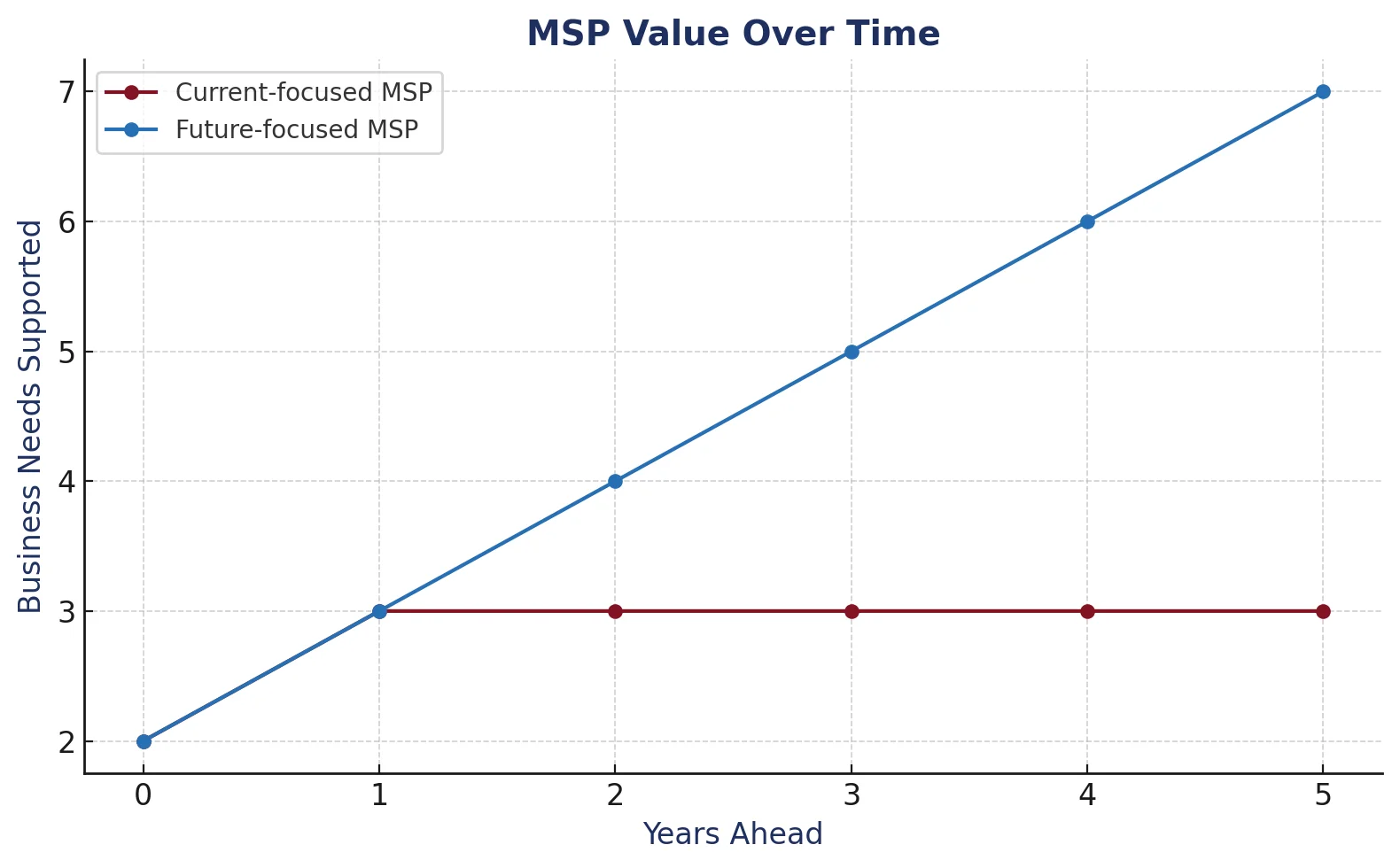
Here is a graphical example to show you what this means (using a 5-year example).


IT Managed Service Challenges

  • Bottom axis (Years Ahead): Time, starting today and looking out over the next 5 years.
  • Side axis (Business Needs Supported): How well the MSP keeps up as your company grows or changes.

Red Line (Current-focused MSP):

  • Works fine for today’s needs.
  • Stops improving after the first year or two.
  • This provider is good in the short term but won’t keep up as demands increase.

Blue Line (Future-focused MSP):

  • Meets today’s needs just like the red line.
  • Keeps climbing year after year.
  • This provider adjusts as your company expands, restructures, or faces new rules.

This chart shows why it’s smarter to choose an MSP that supports your future plans, not just today’s projects.

Outline Support Expectations

Think about what support looks like for your team. Some organizations expect round-the-clock access, while others need structured escalation paths. Clarifying this helps you see which providers can meet the level of service you require.

Weigh Industry Expertise

Some MSPs specialize in certain industries. If compliance or niche software plays a large role in your operations, you will need a provider with experience in those areas. Without that, their support may not extend to the tools or rules you depend on.

Determine Budget

Every organization has limits on what it can spend. Defining a realistic budget helps you focus on providers that can deliver value within those boundaries rather than overselling or underdelivering.

Find a Cutting-Edge IT Service Provider Without The Managed IT Challenges

Find Out If DKBinnovative is The MSP Who Will Prevent Your Managed Service Challenges

An MSP can help you streamline operations. Some research shows that working with one can even increase your overall efficiency by as much as 60%. However, these benefits will only appear of your provider’s service delivery matches your needs.

At DKBinnovative, we’re proud of our ability to adapt to a wide range of clientele. We listen to your needs and cater our services to them. Our goal is to assist you with processes that you know work, not to push you into a system that doesn’t fit your business model.

Reach out today to tell us about what you want to achieve!

An Exploration of 8 Key Types of Managed IT Services

Types of Managed IT Services


In a previous blog post, we explored what managed IT services are and why they’re beneficial. However, managed service providers (MSPs) offer different types of managed IT services. Most will offer more than one type, but not all will offer all types.

“You may have heard about the benefits of managed IT. While these benefits are valuable, there is a catch. That catch is your need to select the right types of services to meet your needs.” Mike Walsh, Chief Operating Officer, DKBinnovative

For this reason, you need to recognize the differences between different types of managed services. Knowing these differences can help you choose an MSP who is more likely to meet your needs. Once you understand your business goals, you can explore various types of managed services that can help you meet them.

That’s what this article is here to help you understand. We will explore 8 key types of managed IT services, how they can benefit your operations, and what the best use case for each service offering is.


8 Types of Managed Services


1. Co-Managed IT Services

Co-managed IT services let you combine your internal IT team with outside support from a managed services provider. The MSP fills gaps in expertise, staffing, or availability while still giving the internal team control over day-to-day IT tasks.

This model is a cost-effective option for companies that have IT staff but need help with scaling, specialized skills, or 24/7 coverage. It’s also a good fit if your team is falling behind on strategic initiatives due to constant break/fix work.

This service contrasts with the typical MSP model that involves full outsourcing. Filling in skill gaps is the usual use case for choosing co-managed over fully managed IT, but it’s not the only one. Here are some more example use cases.

Fully Managed IT Co-Managed IT
No internal IT staff is available or planned An internal IT team exists but needs extra support
The business wants to fully outsource IT operations The team handles daily tasks but needs help with larger projects
Leadership wants to offload all IT responsibilities The IT team needs help managing advanced infrastructure or security
There’s no time or budget to build and retain an in-house team Current staff lacks specific certifications or deep expertise in certain technologies
The company needs consistent IT coverage without managing shifts or coverage gaps In-house staff is overloaded with support requests and can’t focus on improvements
Business requires a single point of accountability for all IT services The team wants to maintain control while accessing scalable resources when needed
The company prefers a turnkey solution with predictable pricing The business has seasonal needs that temporarily exceed internal capacity


2. Virtual CIO (vCIO) Services

Virtual CIO services give companies access to executive-level IT guidance without hiring a full-time chief information officer. A vCIO helps set long-term IT strategies, plan budgets, align technology with business goals, and oversee major projects or decisions.

vCIO services are ideal for small to mid-sized businesses that don’t have in-house strategic IT leadership but still want to make smart, forward-looking tech decisions. It’s especially useful during periods of rapid growth, mergers, or while replacing outdated systems.


3. Managed Security Services

Some providers specialize in data protection as their sole business model. These providers are known as managed security service providers (MSSP). However, many MSPs also offer powerful threat detection and response capabilities that are on par with MSSPs.

Any organization of any size or in any industry can benefit from managed security services, whether from an MSP or MSSP. Cyber threats are evolving rapidly, but organizations that trust an expert partner with their cybersecurity lower security costs by 27% and detect emerging threats 76% faster.

Minimize Downtime by Minimizing Disruptions

Get 24/7 System Monitoring


4. Cloud Management Services

Cloud management services help businesses run and optimize their cloud computing platforms. These services include cloud migration, cost tracking, security controls, performance monitoring, and day-to-day management of hosted applications or services.

Businesses moving off legacy systems, expanding into remote work, or adopting SaaS tools benefit from this service. It’s especially useful for teams that don’t have cloud expertise or need help managing spending across multiple platforms like Microsoft Azure, Amazon Web Services, or Google Cloud.

Furthermore, this type of service can also simply be a way to free your internal team from the burden of managing your cloud infrastructure.


5. Compliance & Risk Management Services

Compliance and risk management services help businesses meet regulatory requirements and manage operational risks related to IT systems. The MSP reviews policies, systems, and user behavior to identify gaps and support documentation efforts.

Having this help can both reduce your risk of mistakes and expedite the process. For instance, CloudSecureTech notes that CMMC certification can take 6 to 18 months to complete. This is a long time to wait if you need that certification for certain business deals.

While you mustn’t rush the process to the point where you make careless mistakes, the help of an MSP can make it happen faster.

Learn More About How The Right IT Partner Could Help You


6. Device Lifecycle & Infrastructure Management

Device and infrastructure management covers the full life of IT assets. The MSP keeps inventory records, standardizes configurations, and monitors health and performance. This service also includes help desk support for device issues, warranty tracking, vendor coordination, and upgrade planning.

Having this service is particularly important for growing companies that need consistency across remote teams, rely on hybrid work models, or don’t have time to manage aging hardware and infrastructure on their own.


7. Patch Management & System Updates

Patch management covers the testing, scheduling, and installation of security patches and system updates across a business’s devices and software. The MSP tracks new releases, applies them in a controlled way, and verifies that updates don’t cause system conflicts.

Businesses with limited IT staff or those using a wide mix of applications and operating systems benefit the most. It’s also important for any company under pressure to prove they’re actively reducing risks tied to outdated software.

Types of Managed Services


8. Managed Backup & Disaster Recovery (BDR)

Most organizations understand the value of regularly backing up their data. The problem is that many data backups are not tested. 25% of organizations test their data backups once a year or less, which means they are at risk of the backup not working when it’s truly needed.

The right MSP can take on this task on your behalf. The MSP sets the backup schedule, stores the data in secure locations, and tests recovery plans on a regular basis. The goal is to recover systems quickly with minimal data loss and avoid extended interruptions to business operations.

This service is essential for any company that can’t afford data loss or long periods of downtime. It’s especially valuable for industries with service-level agreements (SLAs), sensitive customer data, or strict uptime requirements.

Find The Perfect Balance of IT Services From a Texas-Based IT Provider
Plano Frisco Irving


Enjoy All 8 of These Different Types of Managed IT Services From DKB

As mentioned, not all MSPs will offer all types of managed IT services. This article also only listed 8 of all the different types out there. However, if you feel like these 8 services could all benefit your organization, an MSP that provides them all is available.

That MSP is DKBInnovative. Our team will help yours increase operational efficiency by optimizing your technology’s functionality through real-time monitoring and support. Choosing our services ensures that you always have a team on hand who is ready to help you with your next step.

Reach out to book your consultation today!

WARNING! North Korean IT Worker Threats

The conversation around cybersecurity typically centers on ransomware, phishing emails, and vulnerabilities in outdated software. But a new threat is emerging, one that bypasses your firewall and walks through the front door: fake IT workers posing as remote freelancers.

On July 23, 2025, the FBI, in coordination with CISA and the U.S. Department of State, issued an official Public Service Announcement warning that North Korean operatives are actively targeting U.S. companies by posing as IT professionals. These state-sponsored actors infiltrate businesses by blending into remote workforces, often using freelance platforms, fake resumes, and even deepfake-enabled video interviews to obscure their identities. Once embedded, they can exfiltrate data, deploy malware, or use company infrastructure as a springboard for larger attacks.

This isn’t theoretical and it’s not limited to major enterprises. It’s already happening in businesses across the country, and many never realize it until it’s too late.

A recent Politico investigation uncovered the case of Christina Chapman, an Arizona woman who unwittingly helped establish a “laptop farm” on behalf of North Korean hackers. Hundreds of devices were used to simulate U.S.-based access points, making it appear as though these workers were logging in from inside the country. In reality, they were remote operatives channeling through compromised systems, some embedded within companies who never asked the right questions during the hiring process.

These are not lone actors. According to KnowBe4’s breakdown, these operatives come with polished resumes, legitimate references, and experience that looks credible on paper. In one case, the fraudster participated in multiple interviews some involving fake documentation, others using video feeds manipulated with deepfake technology. Their approach was sophisticated, persistent, and completely plausible.

The issue isn’t just access. It’s about trust. When these individuals get hired, they’re

granted access to critical systems, proprietary code, and confidential information. Their goal isn’t short-term financial gain, its long-term access, quiet persistence, and the ability to gather intelligence or launch secondary attacks. As The National Law Review explains, “Even companies with limited data may unknowingly enable sanctions violations, compromise clients, or become launching pads for attacks on larger firms.”

And the risk is greater for companies with hybrid or fully remote workforces, particularly those relying on external staffing platforms or offshore talent. Without stringent hiring practices, geographic access controls, or ongoing access monitoring, organizations may be granting administrative privileges to hostile actors without realizing it.

At DKBinnovative, we’re urging our clients and industry peers to treat third-party IT labor with the same scrutiny you would any critical vendor or internal team member. It’s no longer enough to ask for a resume and conduct a quick video call. Businesses must implement multi-layered verification methods, enforce strict geo-restrictions, and evaluate every remote login point for authenticity. Real-time device fingerprinting, ID validation, and location-based controls are not just nice-to-haves they’re now necessary safeguards.

We often tell our clients: cybersecurity isn’t just about technology. It’s about decisions. The decision to hire. The decision to trust. The decision to verify.

This new threat vector changes the calculus of risk management in IT. It’s not about whether a firewall is patched or if your backups are up to date, it’s about who you’re letting in, and what they might be doing once they gain your trust.  Our team can help assess the hidden vulnerabilities in your access stack and protect your environment before someone uses your business as their next launchpad.

How to Choose a Managed IT Service Provider Who Does More Than Fix Problems

How to Choose a Managed IT Service Provider


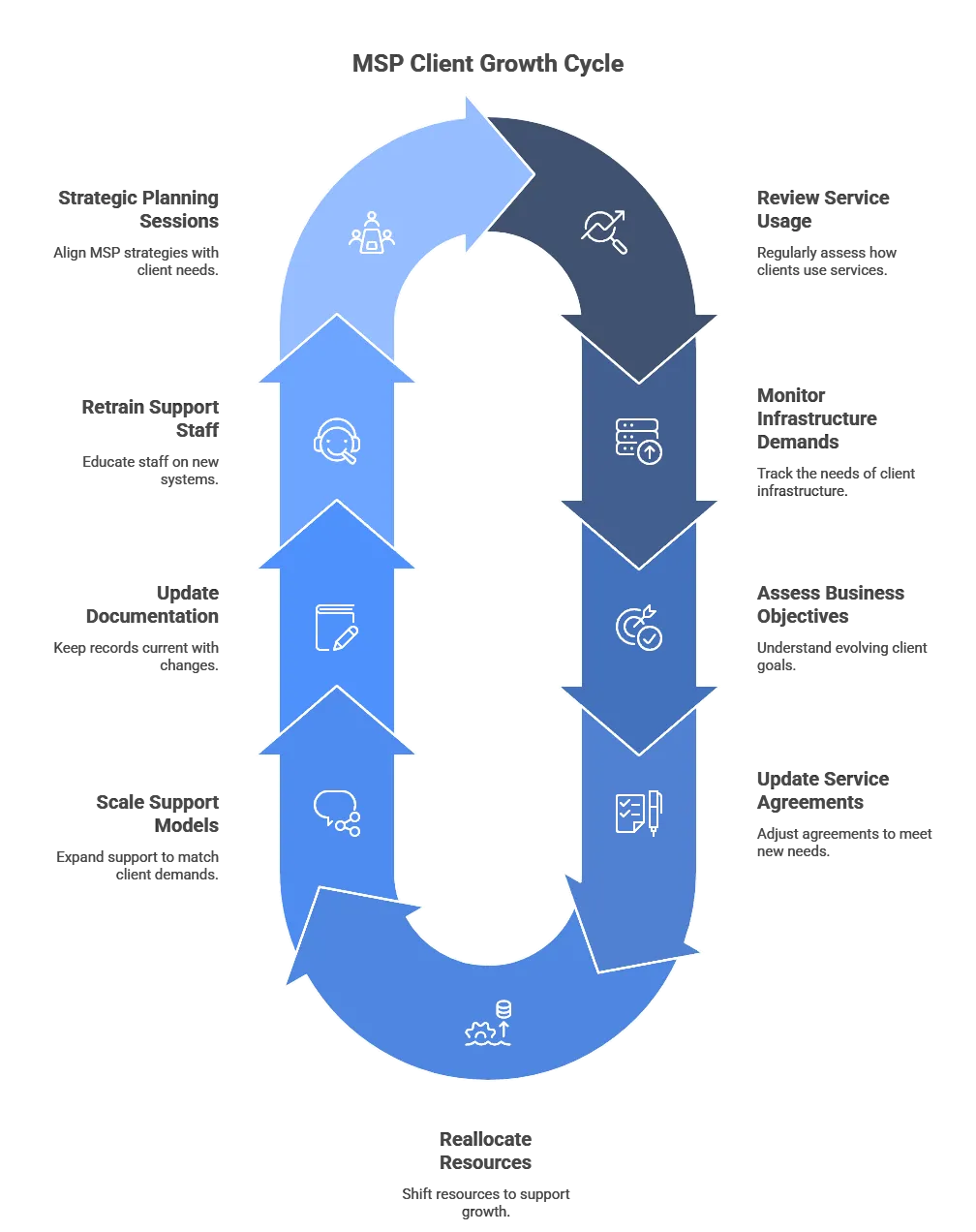
Choosing a managed service provider (MSP) can be a big decision. Most MSPs offer long-term service level agreements (SLAs), so you want certainty that they will be trustworthy. That’s why you must focus on how to choose a managed IT service provider that will do more than simply fix your current IT challenges.

“It’s easy to get caught up in what you want solved immediately. While there is value in finding someone who can solve these issues, you must be mindful not to neglect your future needs for the sake of your current challenges.” Mike Walsh, Chief Operating Officer, DKBinnovative

Focusing too much on a potential MSP who can simply solve what needs to be solved now puts you at risk of choosing someone who you’ll eventually outgrow. What you need today may not reflect what you will need tomorrow. So, you must balance your short- and long-term needs when you choose your MSP qualifying questions.

No one can predict the future, so it who can evolve as your business grows. The rest of this article will show you how to find t’s impossible to truly ask about your future business requirements. However, what you can do is seek an adaptable MSPhat MSP.

What Your Managed Services Vendor Selection Criteria Should Be If You Want an Adaptable Partner


Modular Service Packages

Look for offerings you can bolt on or remove without contract rewrites. Modular design lets you adopt new tools/services or drop unused ones with little downtime. Downtime costs an average $137 per minute for small-to-mid-sized businesses. You certainly don’t want a lack of strategic alignment to be the cause.

Flexible Storage Capacity

Ask whether the provider can add or reduce server or storage space within 4 hours. Quick changes keep systems steady during traffic spikes. That speed proves the MSP scales with you without long waits.

Plus, analysts estimate that about 10 million unused servers lock up $30 billion in hardware, based on a $3,000 price tag per unit. So, fast storage flexibility also helps you save money.

Cloud Services Expertise

Deep cloud knowledge lets the MSP build scalable architectures that expand without physical limits. It also reduces lead times when your staff needs new workloads online. Furthermore, cloud expertise means better cloud-based disaster recovery plans.

Resolve 78% of Your IT Issues in Just One Call

Find Out How


Multi-Site Support Capabilities

It’s estimated that around 2 million multi-unit establishments exist in the United States. So, there is a good chance that you are one of them. If so, verify that the MSP maintains service delivery standards in each region where you operate. Multi-site abilities allow for fast onboarding of new offices with consistent policies. This protects the user experience as your business operations expand.

Growth Forecasting

Request sample reports that project CPU, memory, and internet traffic for 12 months ahead. Accurate forecasts guide timely upgrades before resources run thin. Planning protects performance as demand rises.

Managed Services Questions to Ask to Pinpoint These Needs

While there are certain technical questions to qualify any MSP, there are also specific questions that you can ask about scalability. These questions should go beyond simply asking, “can your services scale with our business growth?” Almost every MSP will simply answer “yes” to that question, whether it’s completely true or not. Instead, ask about these factors to get a good answer.

Growth Strategy

Ask how the MSP plans to grow its support team as clients scale. A provider that relies on the same small crew for all clients may run into service delays as demand rises. You want to hear clear steps for hiring, training, and expanding technical roles when needed.

Onboarding Timelines

Ask how long it typically takes to bring a new location or department online. The answer should include timeframes, steps, and past examples. A provider with established processes in place will have no trouble giving you specifics.

A typical MSP onboarding process follows these steps.

Step What’s Involved
1 Discovery Gather details about your infrastructure, systems, vendors, and existing pain points. Includes interviews with key staff and documentation review.
2 Environment Assessment Perform audits on hardware, software, network setup, security controls, and licensing. Identify risks or unsupported systems.
3 Planning Build a transition plan that includes timelines, communication protocols, and any phased rollouts. Outline priorities based on business impact.
4 Documentation & Access Secure administrator credentials, network diagrams, IP addresses, and system configurations. Set up password vaults and asset tracking.
5 Tool Deployment Install remote monitoring agents, antivirus, backup systems, and other required tools. Test each deployment for functionality.
6 Support Setup Configure service desk routing, escalation paths, and response time expectations. Train staff on how to submit tickets and what to expect.
7 Knowledge Transfer Review documentation with support staff and walk through unique processes, systems, or policies for your organization.
8 Go-Live Begin full-service support. Monitor for issues, validate backups, and confirm access to all critical systems.

Internal Tool Limitations

Ask what internal platforms the MSP uses to manage clients and whether those tools have user or data limits. Some providers hit a ceiling with older systems. You need to know that the tools supporting your IT won’t break down as your team or infrastructure grows.

Client Size Transitions

Ask what percentage of their clients have outgrown the MSP (or grown with them) and what adjustments were made. Their answer will tell you if they’re used to evolving with companies or if they mainly serve static environments. Look for stories of change, not just retention.

Managed Services Vendor Selection Criteria

Project Load Balancing

Ask how many large-scale projects the MSP can run at once. If their team gets stretched thin after just one or two rollouts, that’s a red flag. A capable partner will explain how they divide resources to keep both day-to-day support and project timelines on track.

Learn More About What You Can Gain From Managed IT Services

Escalation Flexibility

Ask how their escalation process changes as ticket volume increases. Some MSPs use static escalation chains that slow down under pressure. Look for answers that show dynamic workflows and options to reroute tasks when volumes spike.

Long-Term Tech Planning

Ask how they help clients revise IT roadmaps as business priorities shift. A good answer includes regular reviews, planning sessions, and clear documentation. It shows the MSP won’t just stick to a plan that no longer fits your needs and impedes your business continuity.

Custom Workflow Support

Ask if they’ve created custom processes or integrations for specific client needs. If they say yes, ask for examples. A provider who tailors their services is willing to adjust operations, not just offer the same setup to everyone.


Explore Your IT Service Options in The State of Texas
Irving Plano Frisco


Find Out If DKBInnovative Fulfills Your Managed IT Services Checklist

Scalability is an important factor when it comes to choosing a managed IT service provider, but it’s not the only one. You also need to consider how your business operates, what types of IT tools you use, and where your internal skill gaps are. Once you know that, you can use it to guide your team toward the ideal partner.

Find out if DKBInnovative is the partner for you. Our team can reduce your recurring IT issues by 40%, which is part of why we’ve earned a 98% satisfaction rating. We can show you how to reduce your risks of cyber threats and your risks of IT system performance issues.

Contact us today to find out how.

16 Billion Passwords Leaked: Why Password Practices Are Necessary

What Businesses in DFW Need to Know—And How to Protect Your Business Now


According to Forbes, a staggering 16 billion usernames and passwords—many tied to Apple, Google, Facebook, and other major platforms—have surfaced on the dark web. This trove of stolen credentials spans multiple breaches and represents one of the largest known exposures of login data to date.

While the headline names are tech giants, the ripple effects hit small and mid-sized businesses just as hard. Why? Because employees often reuse those same credentials across both personal and business systems, leaving you in a vulnerable position.

The reality of a password breach is simple: If your employees use weak, reused, or compromised passwords, your business is one click away from a serious breach.

Why This Should Be a Wake-Up Call

Most attacks don’t start with a brute-force hack—they begin with something as simple as a stolen or reused password.

Once a cybercriminal has one credential, they can:

  • Launch phishing campaigns
  • Access cloud-based systems (Microsoft 365, HR portals, CRMs)
  • Move laterally through your network
  • Encrypt files and hold your data hostage

And it happens more commonly than you think.

A recent Verizon DBIR report found that 86% of web application breaches involve stolen credentials. It’s not hypothetical- it’s happening all around you.

  • Treat Passwords Like Business Assets: DKBinnovative helps clients move from risk to resilience with a layered approach to password security:
  • Enterprise-Grade Password Management: We implement secure password vaults with enforcement policies—so your team doesn’t rely on sticky notes or browser autofill.
  • End-User Training: We don’t just hand out policies—we train your employees to spot phishing attempts and avoid dangerous password practices.
  • Credential Monitoring & Dark Web Scans: We proactively monitor leaked credentials linked to your domain and alert you before attackers do.
  • Multi-Factor Authentication (MFA)” Still optional in your organization? It shouldn’t be. We help implement MFA across all critical platforms.

Every business should take these immediate steps:

  • Require unique passwords for every app and platform
  • Use a reputable password manager company-wide
  • Turn on MFA everywhere
  • Audit accounts for unnecessary admin privileges
  • Schedule ongoing training and awareness (we help with that)

What’s Your Password Risk?

If your team still relies on memory or spreadsheets for passwords, you’re more exposed than you think. Passwords are no longer just a user issue—they’re a business risk. With billions of credentials floating in the wild, the companies that act proactively will be the ones who stay in control.

Let DKBinnovative run a quick password health check across your business.

We’ll show you what attackers already know—and what to do about it.

Visit: dkbinnovative.com/contact or ask us about our Dark Web Credential Scan

What the Whole Foods Cyber Incident Means for DFW Businesses

On June 5, 2025, United Natural Foods Inc. (UNFI), the main distributor for Whole Foods Market, detected unauthorized access within their IT environment. To contain the breach, they shut down critical systems, halting order processing and deliveries across the U.S. 

Within days, Whole Foods locations including those right here in the DFW metroplex reported major shortages in frozen items, dairy, pantry staples, and pharmacy services. Customers walked into half-stocked stores with “We apologize” signs replacing product displays. 

While UNFI began restoring systems later that week, many areas continued experiencing the fallout. Stores scrambled to source alternate suppliers. For many smaller retailers and co-ops, the disruption was devastating. 

 Why It Matters to DFW Businesses 

  1. Supply Chain Risk Isn’t Just for Corporations

You don’t have to be a national grocery chain to feel the pain of a cyber event like this. If your business depends on a third-party logistics partner, online ordering system, or cloud-based software, you’re already in the risk zone. 

In fact, many SMBs in industries like healthcare, construction, private equity, manufacturing, and legal services face similar threats but without the resources of a publicly traded company.

       2. The Real Cost Goes Beyond IT

UNFI’s stock dropped nearly 18%, wiping out millions. But for a small business, the cost of even a few days of downtime, lost sales, missed client deadlines, and broken trust can be existential. 

Would your team know what to do if your vendor were attacked and couldn’t deliver? Could your operations continue if your cloud tools were offline? 

 What This Means for Growing DFW Businesses

  • You Rely on More Tech Than You Realize 

Cloud-based invoicing, CRM tools, inventory systems, supply chain platforms they’re all part of your daily operations. But few small businesses assess the cyber risk behind those tools. 

  • One Vendor Breach = Your Business Offline

Many businesses in North Texas use regional or national distributors, third-party platforms, or even just contractors. If those systems are breached, your business feels the pain immediately.

  •  Most SMBs Have No Incident Plan

Ask yourself: Do we have a playbook if our IT systems go down tomorrow? How do we communicate with customers, continue operations, and recover? 

If not, you are at risk. 

 Proactive Cyber Measures for DFW SMBs 

Action 

Why It Matters 

Audit Your Tech Stack and Vendors

Find out where your single points of failure are before they fail.

Develop a Business Continuity Plan

Know how your business will operate during a cyber event.

Segment Systems & Secure Accounts

Don’t let one compromised login take down your entire network.

Test Your Cyber Readiness

Regular security testing is essential, especially with compliance frameworks like HIPAA or SEC.

Ensure systems are at the appropriate patch level 

Unpatched systems are one of the most common entry points for cyberattacks. Timely updates close known vulnerabilities before attackers can exploit them.


The DFW SMB Landscape is Vulnerable 

At DKBinnovative, we work with small and mid-sized businesses across Dallas, Frisco, Plano, and the broader metroplex and we see it every day: 

  • Outdated or misconfigured cybersecurity tools 
  • Lack of internal security expertise 
  • Understaffed IT teams stretched too thin 
  • Poor visibility into network and endpoint activity 
  • No formal incident response plan 
  • Over reliance on reactive, break-fix IT support 
  • Inadequate user training and phishing awareness 
  • Compliance gaps in industries like legal, healthcare, and finance 

And yet, these same businesses are growing fast, adding headcount, expanding offices, merging with other firms that is increasing their risk at the same time.  

You don’t need enterprise budgets to build resilience. You just need the right strategy and the right partner who can customize a necessary approach to your Business.  

The Bottom Line 

The Whole Foods–UNFI cyber incident isn’t just a cautionary tale for grocery chains. It’s a clear message to every business in DFW. 

Your clients, your team, and your reputation depend on your ability to Identify, Protect, detect, respond and recover digital threats, especially those outside your direct control. 

If your current IT strategy is more reactive than resilient, now is the time to change that. 


DKBinnovative 
Secure | Compliant | Growth-Focused IT for DFW Businesses 

 Let’s build your proactive roadmap: dkbinnovative.com 

Protect your Business from Data Loss with Reliable Backup and Recovery IT Services

Not in the mood for details? Click here to go to the summary

On this Page:

Understanding the risks of data loss

In a post-pandemic world, data has become even more critical for businesses. With the increasing reliance on digital systems and remote work, the risk of data loss has also grown exponentially. Data loss can occur for various reasons, such as hardware failure, natural disasters, cyberattacks, or human error. Businesses need to understand the risks associated with data compromise to take proactive measures to protect their valuable information.

Loss of information can damage a company’s reputation and erode customer trust, which can be challenging to recover. Losing critical data can lead to costly downtime, loss of productivity, and missed opportunities. Furthermore, companies may face legal and regulatory consequences if they fail to protect sensitive customer information. 

Another risk of data compromise is the loss of intellectual property. Businesses often store valuable trade secrets, proprietary information, and research data crucial for their competitive advantage. If this data is compromised, it can devastate the company, resulting in significant financial and reputational harm.

The loss of data can disrupt business functions and contribute to operational inefficiencies. Without access to critical data, employees may be unable to perform their tasks effectively, leading to delays, errors, and frustration. This cannot only impact productivity but also hinder decision-making processes.

The risks of data loss are significant and can have severe consequences for businesses. Understanding these risks is the first step towards implementing effective data backup and recovery services to safeguard valuable information.

The consequences of insufficient backup and recovery services

Not having reliable backup and recovery services can have dire consequences for businesses. Without a proper backup system, data loss can result in permanent data deletion, leaving businesses vulnerable and unable to retrieve valuable information.

One of the significant consequences of insufficient backup and recovery services is the potential loss of customer trust. Customers anticipate businesses will safeguard their data, regardless of their awareness regarding the organization’s security measures. If a business encounters a data loss incident and cannot recover the lost data, it could erode customers’ confidence in the company’s capacity to safeguard their information. This can result in customer attrition and reduced revenue.

Another consequence of not having backup and recovery services is the financial impact it can have on businesses. Data loss can result in costly downtime, as employees may need help accessing critical information to perform their duties. This can lead to delays in delivering products or services, resulting in lost sales and revenue. Businesses may also face legal and regulatory consequences if they cannot recover and protect sensitive customer information.

The lack of backup and recovery services can challenge business continuity. In the event of an  incident, it may take significant time and effort to recover the information, causing disruptions in business operations. This can lead to operational inefficiencies, decreased productivity, and increased employee frustration.

To avoid these dire consequences, businesses must invest in reliable backup and recovery services to ensure the safety and recoverability of their critical data.

Benefits of data backup and recovery services

Implementing data backup and recovery services offers numerous benefits:

1. Data protection: Backup and recovery services provide a reliable and secure way to protect business data. By regularly backing up data, the business can ensure that it is safe from potential threats such as hardware failure, cyberattacks, or natural disasters.

2. Business continuity: In a data loss incident, backup and recovery services enable businesses to restore their critical data and resume normal operations quickly. This helps minimize downtime, maintain productivity, and prevent financial losses.

3. Compliance and legal requirements: Many industries have specific regulationsregarding data protection and retention. Implementing backup and recovery services can help businesses meet these compliance requirements and avoid potential legal consequences.

4. Competitive advantage: A robust backup and recovery system can provide a competitive edge. It demonstrates to customers and partners that a business takes data security seriously, enhancing reputation and building trust.

5. Peace of mind: Knowing that business data is securely backed up and can be swiftly recovered in a data loss incident instills a sense of security. It enables businesses to concentrate on their core operations without the constant concern of potential disruptions.

Overall, data backup and recovery services offer a range of benefits that help businesses protect their valuable information and ensure business continuity.

Choosing the right backup and recovery solution

Selecting the proper backup and recovery solution is crucial for businesses to protect their data effectively. Here are some factors to consider when choosing a backup and recovery solution:

1. Reliability: Choosing a reliable solution that provides high data protection is essential. Look for features such as automated backups, encryption, and redundancy to ensure the safety and integrity of business data.

2. Scalability: Consider the business’s current and future data storage needs. Choose a solution that can quickly scale with business growth, allowing additional storage capacity as needed.

3. Compatibility: Ensure the backup and recovery solution is compatible with existing IT infrastructure and systems. The solution should seamlessly integrate with current software and hardware to avoid compatibility issues.

4. Ease of use: Look for a user-friendly and easy-to-manage solution. A complicated backup and recovery system may require extensive training and expertise, which can be time-consuming and costly.

5. Support and maintenance: Consider the level of support and maintenance provided by the backup and recovery solution provider. It is essential to have access to technical support in case of any issues or emergencies.

By carefully evaluating these factors and assessing business needs, companies can choose the backup and recovery solution that best suits their requirements. This ensures that their valuable data is properly protected, and they can effectively recover from any potential data loss incidents. Investing time and effort in selecting the right solution is a critical step towards safeguarding the company’s information and ensuring business continuity.

The MSP’s role in data backup and recovery implementation

Managed Service Providers (MSPs) are crucial in successfully implementing data backup and recovery services. They offer expertise, resources, and support to ensure businesses have a robust and reliable backup system.

Here are some key roles an MSP plays in data backup and recovery implementation:

1. Assessment and planning: An MSP evaluates the current backup and recovery needs of the business and assists in crafting a customized plan to meet the organization’s specific requirements. They analyze the existing infrastructure, data volume, and criticality to determine the most suitable backup and recovery solution.

2. Implementation and configuration: MSPs handle the implementation and configuration of the backup and recovery solution. They ensure the system is appropriately set up, tested, and integrated with the IT infrastructure. This includes establishing backup schedules, defining recovery point objectives (RPOs) and recovery time objectives (RTOs), and configuring security measures.

3. Monitoring and maintenance: MSPs continuously monitor the backup and recovery system to ensure proper functioning. They proactively identify and resolve any issues or errors to minimize the risk of data loss. Additionally, they perform regular maintenance tasks such as software updates, patch management, and data integrity checks.

4. Disaster recovery planning: MSPs help businesses develop a comprehensive disaster recovery plan that outlines the steps to be taken during a data loss incident. They assist in defining recovery strategies, prioritizing critical systems and data, and conducting regular recovery drills to ensure readiness.

5. Support and troubleshooting: MSPs provide ongoing support and troubleshooting services to address any issues or concerns related to backup and recovery. They deliver technical assistance, address queries, and provide guidance to ensure a smooth and efficient backup and recovery process.

By partnering with an MSP, businesses can leverage their expertise and resources to implement a robust backup and recovery system that protects their data and ensures business continuity.

Just the Facts

The importance of reliable backup and recovery services cannot be overstated in today’s digital landscape. Businesses that acknowledge and act upon the risks of data loss by implementing robust backup and recovery strategies stand to gain security and a significant competitive advantage.

The peace of mind that comes with knowing your business is prepared for any data loss incident is invaluable. A comprehensive backup and recovery solution, tailored to your business needs and supported by the expertise of a Managed Service Provider like DKBinnovative, will protect your critical data, ensure regulatory compliance, maintain customer trust, and safeguard your company’s future.

Take action now to protect your business from the devastating effects of data loss; it’s not just a safety measure; it’s a strategic business imperative.

If you have any questions we’d love to hear from you! Share them with us over on:

What Are Managed IT Services? Understanding the Value Beyond Support

what are managed it services

In today’s fast-paced, digital-first world, businesses depend on technology to stay efficient, competitive, and connected. But what happens when that technology fails—when systems crash, productivity stalls, or cyber threats strike?

Too often, small to midsize businesses still rely on the outdated break-fix model, calling for IT help only after something goes wrong. The cost? More than just frustration.

According to a report, “60% of small businesses shut down within six months of a cyberattack.” 

That kind of disruption creates more than downtime—it builds a backlog of tech debt, lost trust, and missed opportunities that can seriously limit your growth.

Mike Walsh, Chief Operating Officer, DKBinnovative says, “Today’s IT teams are stretched thin—outsourcing is no longer a luxury; it’s a business necessity.”

That’s where managed IT services come in.

Get Expert IT Support with DKBinnovative

With 24/7 support, real-time monitoring, and a proactive mindset, we help you work smarter—not harder.
Book a FREE Consultation

What Are Managed IT Services? (In Simple Terms)

Managed IT services refer to the proactive outsourcing of your entire IT operations to a third-party company—known as a Managed Services Provider (MSP). This includes everything from day-to-day tech support to cybersecurity, cloud management, network monitoring, data backups, and even strategic IT consulting.

Rather than reacting to problems as they arise, managed IT services are designed to prevent issues before they disrupt your business. You get a full team of experts constantly working behind the scenes to keep your systems running smoothly, securely, and efficiently.

Managed IT Services Definition (For Real-World Businesses)

If you’re looking for a clear, straightforward managed IT services definition—here it is.

Managed IT services are a subscription-based model where a third-party IT provider manages and assumes responsibility for your business’s IT systems, offering ongoing support, security, monitoring, and strategic guidance for a flat monthly fee.

This model replaces unpredictable hourly charges with a consistent, fixed-cost agreement. It’s like having your own IT department—without the overhead.

This managed IT definition shifts the focus from break/fix to strategic enablement. You’re not just solving problems—you’re building an infrastructure that supports growth, agility, and resilience.

More articles you might like:

How Managed Services Work (Step-by-Step Breakdown)

Still wondering how managed services work behind the scenes? Here’s a look at what happens when you partner with an MSP:

1. Initial Assessment

Every business has a unique IT landscape. A good managed services provider starts by evaluating your current systems—hardware, software, networks, security, and workflows—to identify gaps and opportunities.

2. Customized Plan

Based on the assessment, the provider develops a tailored IT strategy and service agreement that fits your business size, industry, and goals. This plan typically includes cybersecurity, backup, support, cloud management, and network monitoring.

3. Onboarding and Optimization

Next comes the transition phase. The MSP takes over your infrastructure, implements new tools (if needed), and begins optimizing performance. This can involve upgrading systems, improving security configurations, or migrating to better platforms.

4. 24/7 Monitoring and Maintenance

Here’s where the magic happens. Your MSP continuously monitors your systems in real time, identifying vulnerabilities or irregular activity before it causes problems. Automatic patches, updates, and backups keep your environment current and safe.

5. Ongoing Support

Whether your team needs help resetting a password or resolving a server issue, the MSP’s helpdesk is available—often 24/7. This ensures minimal downtime and quick resolution to everyday tech issues.

6. Strategic IT Consulting

Top-tier providers go beyond troubleshooting. They meet with your leadership regularly to align IT with your business goals—helping you plan upgrades, manage budgets, ensure compliance, and scale effectively.
This entire model explains what managed services offer: predictable, comprehensive support that grows with you.


Managed IT Services Meaning for Business Owners

So what does managed IT services really mean for small and midsize businesses?

It means you get to focus on running your business while experts handle your technology.

  • No more chasing down random tech contractors
  • No more surprise bills from unexpected outages
  • No more falling behind on cybersecurity or compliance

Instead, you gain:

  • Predictable IT costs with fixed monthly pricing
  • Enhanced security with proactive threat detection
  • Less downtime thanks to 24/7 monitoring
  • Scalable solutions that evolve as you grow

This isn’t just IT support—it’s a partnership that empowers your business.


What Is an IT Managed Services Provider?

Let’s clearly define what an IT managed services provider is—no jargon, just the facts.

An IT managed services provider (MSP) is a specialized company that offers outsourced IT services, including support, security, maintenance, and strategy. They act as your full-service IT department—without the need to hire one in-house.

A good MSP should feel like an extension of your team. They should be proactive, responsive, transparent, and strategic. Look for providers that offer:

The best MSPs are not just tech support—they are growth enablers.

What Managed Services Include (And What You Should Expect)

Let’s break down what managed services usually include. While offerings can vary, a solid package typically covers:

Service Category What’s Included Why It Matters
Helpdesk Support Unlimited access to IT experts via phone, email, or chat Fast resolutions reduce employee frustration
Network Monitoring 24/7 tracking of performance, uptime, and security events Stops problems before they cause downtime
Cybersecurity Antivirus, firewalls, patch management, threat detection Protects against breaches and ransomware
Cloud Management Microsoft 365, Google Workspace, file storage, backups Streamlines access and disaster recovery
Backup & Recovery Automated, encrypted backups with quick recovery options Keeps data safe and reduces downtime
IT Strategy Ongoing technology planning and budget forecasting Aligns tech with business goals and growth
Compliance Support HIPAA, SOC 2, GDPR, and other standards guidance Avoids costly fines and legal issues

Why Managed IT Is Becoming the New Standard

With cyberattacks on the rise and digital transformation accelerating, managed IT services are becoming essential.

That’s why more businesses are replacing outdated IT models with proactive, expert-led solutions.

Final Thoughts: Why It’s Time to Rethink Your IT Strategy

To recap:

  • You’ve learned what are managed IT services and why they matter.
  • By now, you have a clear understanding of both the managed IT services definition and the broader managed IT definition.
  • You’ve explored how managed services work and what managed services typically include.
  • And you’ve clearly answered what is an IT managed services provider.

If your current IT approach is reactive, unpredictable, or falling short—it’s time to consider managed IT.

DKBinnovative helps businesses like yours thrive with proactive IT solutions tailored to your goals. Contact us today to schedule a free consultation and experience the future of IT management.

Trusted IT Services Near You

Managed IT IT Support
IT Consulting Cybersecurity

Sales Number
(888) 295-0677

Support Number
(888) 352-4832

(888) 352-4832
[email protected]

1701 Legacy Dr, #1450
Frisco, TX 75034