
Here’s How to Avoid Managed IT Service Challenges



With approximately 8,000 managed IT services providers (MSPs) in the USA alone, there will doubtless be some that are better than others. However, it’s also important to recognize that many managed IT service challenges aren’t a result of the provider’s quality. Sometimes, it simply means that MSP wasn’t the best fit for your organization.
|
“Choosing an MSP isn’t as simple as choosing a ‘good’ or ‘bad’ one; it’s about choosing the one that makes the most sense for your needs and goals.” – Mike Walsh, Chief Operating Officer, DKBinnovative
|
The problem is that detecting MSPs who will be a bad fit for you is less obvious than detecting poor quality ones. It’s easy to see who underperforms. It’s not as easy to see who has different goals and values compared to yours.
That’s what this article will help you learn. We will go over the steps that you can take to zero in on what you want out of an MSP, and the challenges that finding a good fit will help you avoid.
6 Managed IT Service Challenges You May Face With a Poor Fit
1. Misaligned Business Priorities
Conflict can arise if your priorities don’t match. For instance, an MSP might push for rapid technology adoption while your team prioritizes stability. In other cases, the MSP may stress cost savings when your leadership values growth and scalability.
This mismatch leads to frustration on both sides. The provider may see your organization as resistant to progress, while you may feel pressured into decisions that do not fit you.
2. Communication Style Gaps
Some MSPs deliver long technical reports. Others share short updates that lack detail. If the style does not match how your staff processes information, important details may be missed. The result is confusion about project status, unclear expectations, and strained relationships between your team and the provider.
Hear From Friendly IT Support Staff in Just 3 Minutes on Average! No More Managed IT Service Challenges! |
3. Different Risk Tolerance
Organizations vary in how much risk they are willing to accept. A provider with a strict, compliance-heavy mindset may overcomplicate simple processes if your company operates with more flexibility. On the other hand, a provider with a more relaxed approach may leave leadership feeling uneasy.
These differences create tension around budgeting, project timelines, and even day-to-day operations.
4. Cultural Incompatibility
Company culture extends to values, pace, and decision-making style. If your MSP works in a rigid, policy-driven environment while your team values agility, the relationship will struggle. The opposite is also true: a casual provider may frustrate leaders who expect formal processes. Lack of collaboration is actually why 80% of outsourcing relationships fail.
5. Misaligned Service Scope
Some MSPs shape their services around specific industries or company sizes. If your organization does not fall into that focus, the provider may underdeliver in the areas you need most, even while performing well in other areas.
6. Conflicting Growth Expectations
Your MSP may expect to grow with you, while your leadership may view them as a short-term partner. Conversely, your business may plan for aggressive scaling, and the provider may not be structured to expand at the same pace. These conflicting views stall projects and create planning disputes.
|
What Else You Should Know to Avoid Managed Service Challenges
|
How to Truly Zero In on What You Want Out of an MSP
Define Business Goals
Start with what your organization wants to achieve. If growth, stability, or cost control are your top priorities, name them clearly. An MSP can only align with your direction if those goals are on the table from the start.
Map Internal Pain Points
List the areas where your team struggles most today. Whether it is slow response times, recurring outages, or ensuring compliance, knowing where the pain lies makes it easier to judge who can relieve it.
Identify Long-Term Needs
Think beyond your immediate projects. Consider whether you expect significant growth, restructuring, or regulatory changes in the next few years. An MSP that fits your future plans will be more valuable than one that only solves today’s challenges.
Here is a graphical example to show you what this means (using a 5-year example).
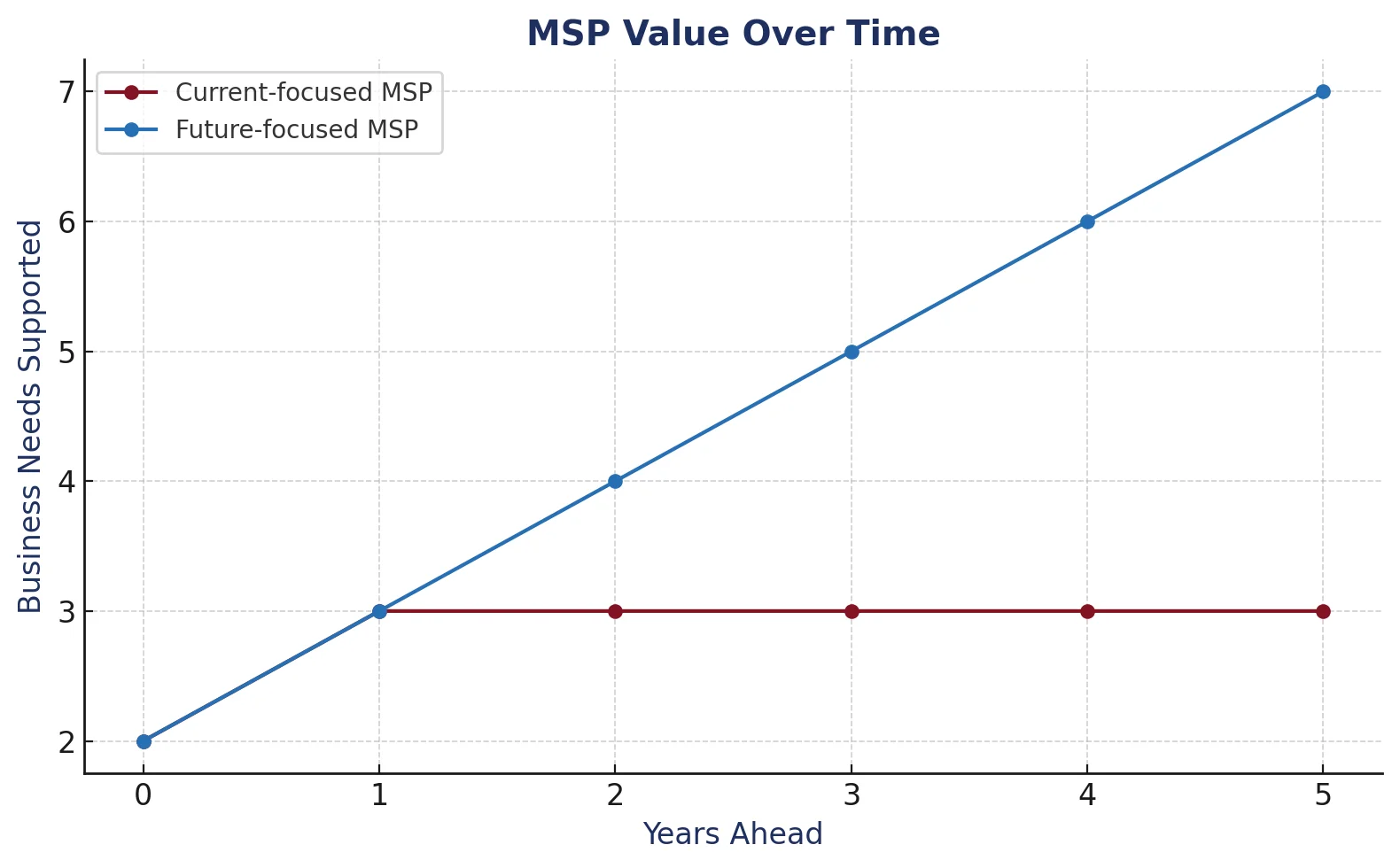
Red Line (Current-focused MSP):
Blue Line (Future-focused MSP):
|
This chart shows why it’s smarter to choose an MSP that supports your future plans, not just today’s projects.
Outline Support Expectations
Think about what support looks like for your team. Some organizations expect round-the-clock access, while others need structured escalation paths. Clarifying this helps you see which providers can meet the level of service you require.
Weigh Industry Expertise
Some MSPs specialize in certain industries. If compliance or niche software plays a large role in your operations, you will need a provider with experience in those areas. Without that, their support may not extend to the tools or rules you depend on.
Determine Budget
Every organization has limits on what it can spend. Defining a realistic budget helps you focus on providers that can deliver value within those boundaries rather than overselling or underdelivering.
|
Find a Cutting-Edge IT Service Provider Without The Managed IT Challenges
|
||
Find Out If DKBinnovative is The MSP Who Will Prevent Your Managed Service Challenges
An MSP can help you streamline operations. Some research shows that working with one can even increase your overall efficiency by as much as 60%. However, these benefits will only appear of your provider’s service delivery matches your needs.
At DKBinnovative, we’re proud of our ability to adapt to a wide range of clientele. We listen to your needs and cater our services to them. Our goal is to assist you with processes that you know work, not to push you into a system that doesn’t fit your business model.
Reach out today to tell us about what you want to achieve!
Serving the DFW Metroplex

